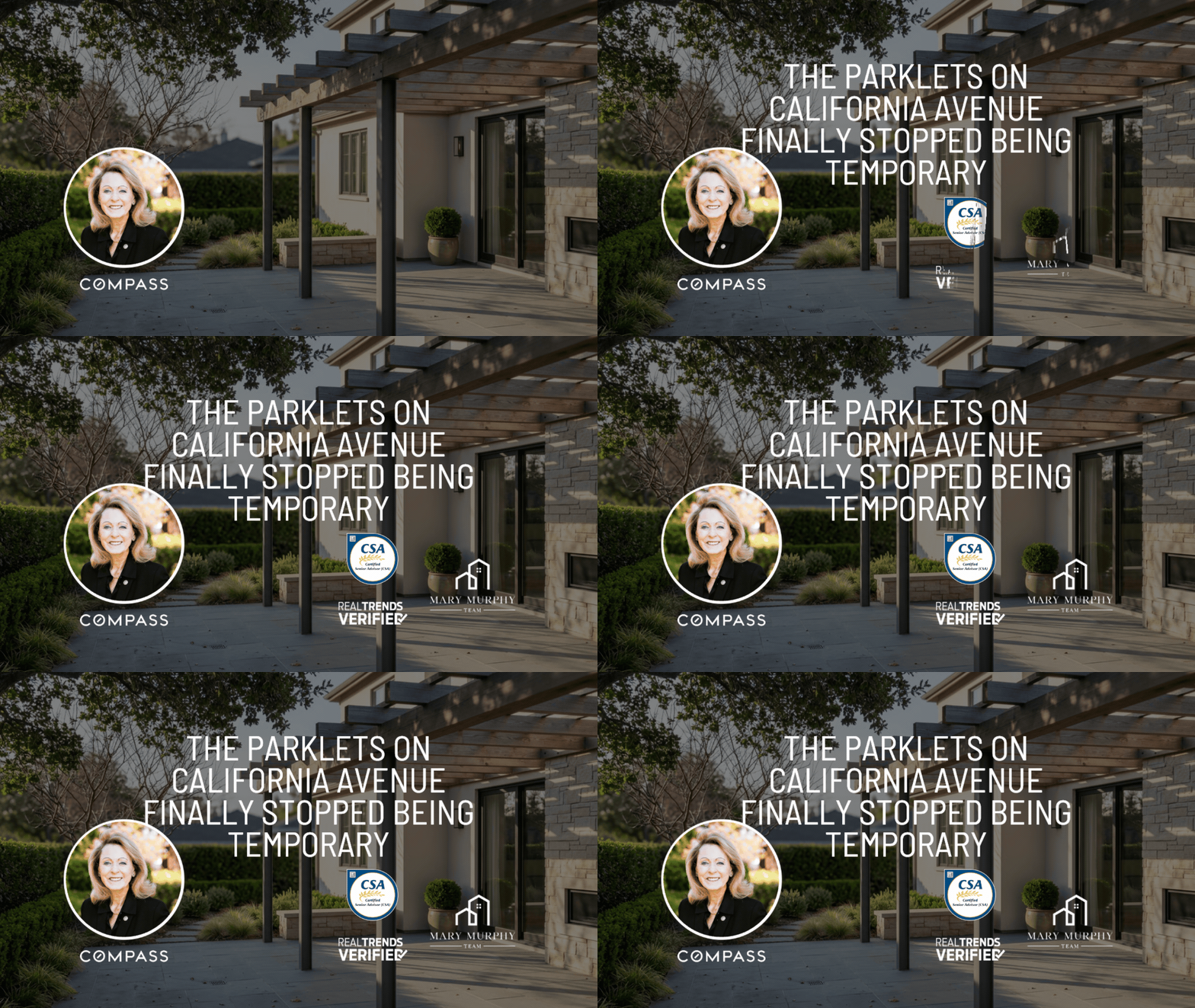
Order a coffee on California Avenue this week and look up before you sit down. The roof over the parklet has rafters now. It has flashing where the structure meets the building, and posts bolted into the pavement instead of sandbags holding down a tarp. Somebody measured this thing.
That detail matters more than any single restaurant opening or concert night this summer, because it marks the end of an arrangement that lasted six years longer than anyone planned. When Palo Alto closed the stretch of Cal Ave between El Camino Real and Birch Street to cars in June 2020, the wood-framed dining structures that popped up in the road were built as an emergency measure. City Council kept renewing that emergency status roughly once a quarter, year after year, without ever converting it into a real plan. On June 1, 2026, the council finally signed off on permanent design standards. The block stopped being a stopgap and became something built on purpose.
Six Years of "We'll Decide Later"
The delay was not for lack of trying. An early proposal would have swept away the tent-and-parklet look entirely in favor of open tables under umbrellas, a cleaner streetscape on paper. Restaurant owners fought it, and the argument that won was blunt: this is the Peninsula, not Palm Springs, and diners do not sit outside in January rain under an umbrella with no roof. The Palo Alto Chamber of Commerce made the same case directly to the council, warning that without weatherproof seating, the businesses that had built their model around car-free outdoor dining were exposed every time it rained.
The city kept pushing the decision to the next quarter while the Architectural Review Board worked through the design, and the target date slid from an original 2025 timeline into spring 2026, then to June. Six years is a long time to run a commercial district on permits nobody expected to still be renewing.
What the Council Actually Approved
The final standard gives merchants three options for the car-free stretch: a cabana with a sloped roof and overhangs, a pergola with a flat roof, or a simpler roofless parklet for businesses that want it. All three replace the improvised tent-and-tarp look that has defined Cal Ave since 2020.
The more consequential fight was over bicycles. The city's original vision for Cal Ave included a dedicated two-way bike lane running down the center of the closed street. Council members reversed course, worried that a bike lane threading between pedestrian-packed parklets would put cyclists on a collision course with people carrying trays. What they approved instead is a compromise: thermoplastic bands laid across the pavement that create a bumpy ride for cyclists rolling over them, discouraging speed without banning bikes outright. Bruce Fukuji, the urban architect who has led the Cal Ave design work, described the goal as creating "behavioral cues" rather than hard rules.
Mayor Vicki Veenker summed up the council's mood at the June 1 meeting, calling the redesign a chance with real upside if the city executes it well. Getting there, staff noted, will also depend on merchants keeping the new structures clear enough for emergency vehicles to pass, a responsibility that comes with permanence.
A Concert Series Under a New Name
The other visible change this year is on the calendar, not the pavement. For two and a half years, Cal Ave's monthly street event was called 3rd Thursday. That series ended in October 2025, and this spring the city launched a replacement called Thursday Live on Cal Ave, running one Thursday evening a month from May through September, plus a special daytime event to close out October.
The official city event page frames it as live music, themed activities, games and giveaways. The inaugural night on May 28 leaned into that literally: the centerpiece was a luxury car show curated by Auto Vino and presented by Terün Pizzeria, with the Terün Family Band playing the Ash Street stage and local rockers Past Curfew on the El Camino stage. It was, for one night, cars back on a street that spent six years getting rid of them.
Here's the season as it stands:
Date | Theme |
|---|---|
May 28 | Launch night, car show with Auto Vino and Terün |
June 25 | A Taste of Cal Ave, world music |
July 30 | Wine walk |
August 27 | Wellness and end-of-summer program |
September 24 | Harvest festival with jazz |
October 31 | Halloween and Oktoberfest, daytime special |
Sahlik Khan, who heads operations at Zareen's on Cal Ave, told the council in a letter that foot traffic on the street has "increased tremendously since the closure," and that people are lingering rather than simply passing through on their way somewhere else. That is the argument the city is betting the redesign on: that a closed street with a reliable events calendar behaves differently than a closed street with nothing happening on it.
The Names You'll Recognize at the Ribbon Cutting
The restaurants testifying in favor of the parklet redesign were not newcomers guessing at what Cal Ave needs. iTalico, Terün, and Zareen's have all operated on this block long enough to have opinions about what works, and their letters to the council carried weight because of it. Joanie's Café, the longtime anchor near the middle of the strip, was close enough to the May 28 launch that the sound of the opening set carried past its windows.
The one name still on the way is Croissanté, a French bakery with existing outposts in Santa Clara and Los Gatos that is taking over 321 California Ave, the former home of the dive bar Antonio's Nut House. Owner Sean Kang has said the opening slipped to late 2026 after what he called a significant delay, which means the storefront that has sat dark through most of this transformation will likely still be dark when the harvest festival rolls through in September.
The Corner That Is Still Undecided
Not every part of the block got resolved on June 1. At the California Avenue end near El Camino Real sits the Mollie Stone's Market site, and Redco Development has an active proposal for three residential towers there, one at 14 stories and two at 12. That is down from an original pitch of 17 stories, trimmed after months of negotiation with city officials and the threat of litigation hanging over the talks.
Whatever the final design looks like, that much housing landing on the west end of the strip will do more to reshape the daily rhythm of Cal Ave than any parklet vote. Residents who live near that corner should expect construction noise and dirt for a stretch of years as the project moves forward, a real consideration for anyone whose routine already runs through that end of the block on the way to the Caltrain platform.
What This Actually Means for the Block
The middle of California Avenue finally has a settled shape. The parklets are permanent structures now instead of six-year-old emergency fixtures, the bike question got answered even if it is a compromise, and the events calendar has a name and a season of dates through Halloween. That is real progress after six years of quarter-by-quarter extensions.
The west end of the block has not caught up yet. It is still waiting on a development decision that will bring years of construction before it settles into whatever comes next. Anyone who already calls this stretch of Palo Alto home is living through both stories at once this year: one part of the street finally finished deciding what it is, and another part just starting.
If you are weighing what any of this means for your own plans on the Peninsula, whether that is Cal Ave or a neighborhood nearby, the Mary Murphy Team is happy to talk through what we're seeing on the ground. Request a complimentary home valuation and consultation whenever you're ready.
Mary Murphy | 650-773-4999 | [email protected] | Menlo Park and Atherton's trusted guide for life's next chapter
DRE# 00675838

California Avenue FAQ
What changed on California Avenue?
On June 1, 2026, Palo Alto City Council approved permanent design standards for the car-free stretch of Cal Ave between El Camino Real and Birch Street. The wood-framed dining structures that have lined the street since 2020 are no longer temporary emergency fixtures. They're now permanent, code-built structures.
Why did it take six years to make this permanent?
The street closed to cars in June 2020 as a pandemic-era emergency measure. The city kept renewing that emergency status roughly every quarter without converting it into a real plan, pushing the target date from an original 2025 timeline to spring, then finally to June 2026.
What are merchants allowed to build now?
Three options: a cabana with a sloped roof and overhangs, a pergola with a flat roof, or a simpler roofless parklet. All three replace the improvised tent-and-tarp look that defined the street for six years.
What happened with the bike lane debate?
The original plan included a dedicated two-way bike lane down the center of the street. Council reversed course over safety concerns between cyclists and pedestrians navigating packed parklets. The compromise is thermoplastic bands across the pavement designed to slow cyclists without banning bikes outright.
Is 3rd Thursday still happening?
No. That series ended in October 2025. It's been replaced by Thursday Live on Cal Ave, running one Thursday evening a month from May through September, with a daytime Halloween and Oktoberfest event closing out October.
Is there still a vacant storefront on the block?
Yes. Croissanté, a French bakery with locations in Santa Clara and Los Gatos, is taking over the former Antonio's Nut House space at 321 California Ave. Owner Sean Kang has said the opening slipped to late 2026.
What's happening at the west end of the block?
The Mollie Stone's Market site near El Camino Real is the subject of an active Redco Development proposal for three residential towers, one at 14 stories and two at 12, trimmed down from an original 17-story pitch. That decision is still unresolved, and nearby residents should expect years of construction once it moves forward.
Why does this matter if I'm not buying or selling right now?
A block that finally has a settled identity, permanent structures, a real events calendar, and a resolved bike policy, tends to hold and build value differently than one that's still operating on year-to-year uncertainty. It's a useful data point for anyone weighing their own plans on the Peninsula.